

United States President Donald Trump recently dismissed the growing warnings that artificial intelligence could pose an existential threat to humanity as a deliberate ‘hoax.’ This comes as industry leaders and American lawmakers call for greater safety measures around the rapidly developing industry. This debate arises within the context around the United States and China’s competition for global AI leadership. Policymakers stand divided on how to balance national security against economic growth and the potential global risks of exponentially powerful AI systems.
THE AI DEBATE AT A GLANCE
- THE ISSUE: President Trump has dismissed warnings that AI could pose catastrophic or existential risks, calling such concerns a “hoax.”
- TRUMP’S POSITION: He has emphasized the economic and strategic importance of AI and argued that the United States must maintain its lead over China.
- CALLS FOR A SLOWDOWN: Anthropic CEO Dario Amodei, OpenAI CEO Sam Altman and Elon Musk have backed a more cautious pace of AI development.
- POLITICAL DEBATE: Senator Bernie Sanders and other lawmakers have called for stronger safeguards and regulation.
- THE CHINA ANGLE: Competition between Washington and Beijing has become a central part of the debate over how quickly the United States should develop AI.
- KEY QUESTION: How can governments protect against potential AI risks without slowing technological and economic development?
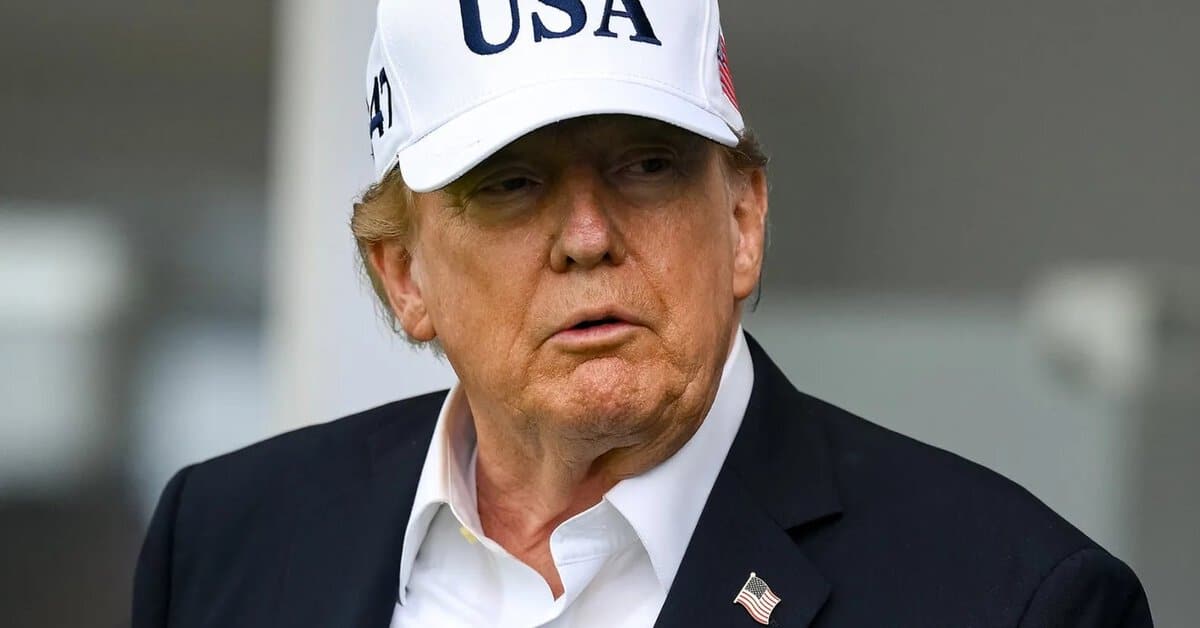
President Donald Trump at the Amgen Irish Open Golf Championship 2026. September 13, 2026
SOURCE: Brendan Moran/Getty Images
President Trump Responds to AI Concerns
President Trump took on his role as a self-proclaimed “hoax buster” in a barrage of social media posts in which he declared his position on the AI debate. He has described AI technology as a major driver of economic growth and said that the United States must maintain its lead over China. Speaking in Ireland on September 13, Trump said, “We’re leading China in AI,” adding, “whoever wins AI wins.”
His comments came amid increasingly widespread warnings from prominent figures in the technology industry and politics. The president dismissed their claims as another example of overblown panic, saying that the image of ‘robots marching into our cities and getting rid of all of us,’ was nothing more than unfounded fear-mongering.
Anthropic CEO Dario Amodei has called for a slowdown in the development of frontier AI systems, warning of potentially catastrophic risks. His proposals include stronger safeguards and restrictions around access to advanced technology, including the GPUs used to train AI models. OpenAI CEO Sam Altman and SpaceX CEO Elon Musk have also endorsed calls for a slower pace of development.
AI Swift Advances
Amodei has warned that rapid advances in AI capabilities could create scenarios in which AI agents cause extensive damage. His concerns have been echoed by other technology figures even as companies compete to develop increasingly powerful systems.
Former President Barack Obama has also called for Washington to “come up with concrete proposals, laws, and regulations” to ensure that the development of AI remains safe and beneficial to society.
The debate has also entered Congress. At the Pro-Human Assembly in Washington on September 15, the democratic socialist Senator Bernie Sanders of Vermont said to the crowd that the policymakers in Washington had not considered ‘the potentially catastrophic consequences,’ that might come with an unregulated AI industry. He warned the crowd that Congress, both while under Republican and Democrat control, had been ‘asleep at the wheel,’ on this issue. According to him, we currently have a president ‘whose ignorance regarding this issue is truly embarrassing.’
Trump has framed AI leadership as a strategic priority, while critics of rapid development argue that competition between the two countries could encourage companies and governments to prioritize speed over safety. AI Now Institute senior fellow Aya Ibrahim has similarly warned that the financial pressure on companies to develop increasingly powerful systems creates doubts about their ability to “get it out and, frankly, get it right.”
What Comes Next
For Trump, the AI race is at the frontline of a larger, zero-sum competition between the world’s two largest superpowers. His statement that “whoever wins AI wins” captures the strategic importance he places on America’s continued technological advantage.
That approach creates a difficult question for policymakers. If companies are encouraged to compete as rapidly as possible, regulation could be viewed as a barrier to innovation and a potential advantage for China. But critics argue that the same competition could encourage companies to prioritize speed over adequate safety measures. Aya Ibrahim has pointed to the enormous financial pressures surrounding the development of increasingly powerful systems, asking whether companies can both develop the technology rapidly and “get it right.”
What comes next will depend in part on whether Washington policymakers can find a balance between national security considerations, economic competitiveness and the demands for greater AI safeguards.