

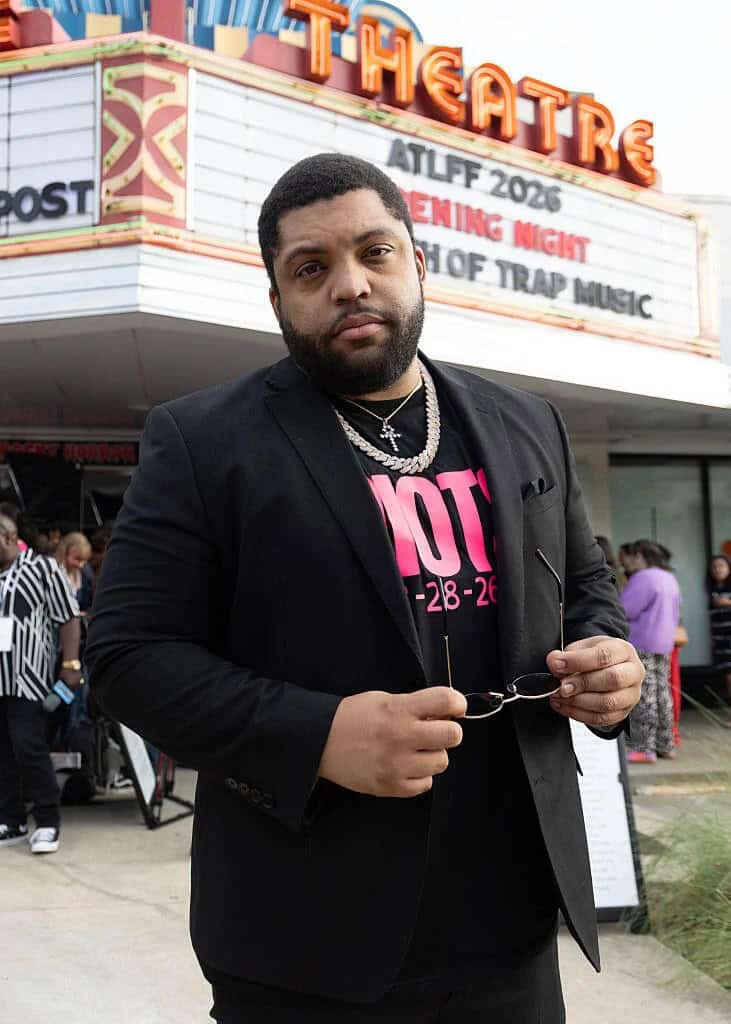
O’Shea Jackson Jr. attends the 2026 Atlanta Film Festival Carol Lee Rose / Getty Images / CarolLeeRose.
In its 50th year, the Atlanta Film Festival has become one of the oldest cultural events in the nation. This year’s festival started on Thursday and is expected to run through May 3. Venues are spread throughout the city, including Plaza Theater and Tara Theater, and a few virtual sessions are scheduled. The opening featured familiar faces. T.I, Drumma Boy, and O’Shea Jackson Jr., the son of Ice Cube, attended screenings for various films.
Thousands of films were submitted, but only 150 made the cut.
In the run to May 3, the event is expected to draw 20,000 people or more. They will be filmmakers, industry professionals, and residents from Atlanta and beyond. The festival plays an important networking role for the community, according to Christopher Escobar. He says it matters to Atlanta because it is “our annual convening of the film community” where everyone from artists to veterans and audiences get to meet.
Scheduled special events such as the IMAGE Film Awards Gala are expected to honor key persons who have shaped the city’s film and television history. Consumer spending at the festival is expected to boost the city’s economy. Escobar: “Our annual festival alone creates over a $3 million impact for the area.’
The travel and food industries will benefit the most.
Attendance numbers are projected to be more than last year, going by the current trend of ticket sales. But Georgia has spent a lot in the fight to become the Hollywood of the South, sometimes sacrificing the principles of healthy business practice. In 2007, the film industry invested a paltry $93 million, bringing Georgia to the light as a bona fide film state. By 2016, everyone wanted a piece of Georgia, and production levies grossed $2 billion.
Even so, Georgia was leaving plenty on the table by giving Hollywood production companies a forever 30% discount on every dollar they spent in the state. Experts estimate that this miscalculation has cost the state’s taxpayers close to $1 billion every year. The $3 million expected from the festival is a drop in the ocean of this loss. It can be described as a hostage situation of Hollywood over Georgia, and the taxpayers pay the ransom.
In the end, they all leave. Marvel left for England after filming in Georgia for a full decade, enjoying $1 billion in tax credits. It’s now cheaper to shoot in the UK, where talent is cheap, and studios don’t pay for actors’ health insurance. The Georgia State University recently found that the state’s incentives earned no more than $19 cents per dollar spent.
The state lost $160,000 for every job the film industry created.
The verdict is that Georgia’s film industry is designed to be a liability because of its tax credits. But others are of the opinion that the state has no film tax credits because it essentially collects near-zero taxes on film production. The festival rightly celebrates the state’s independent film scene and local creativity and culture. The community is real. The networking is real. But the state’s corporate welfare machinery built to benefit Disney, Marvel, and Netflix is also real. Taxpayers foot the bill.