Russian President Vladimir Putin has agreed to resume three-way negotiations with the United States and Ukraine in November after Putin met U.S. envoy Steve Witkoff in St. Petersburg. The talks would be the first of their kind since February, and Moscow says they will focus on a post-war security arrangement for Russia and Ukraine.
This meeting came a day after Witkoff met Ukrainian President Volodymyr Zelenskyy and European leaders in Oslo, as Washington pressed for a deal.
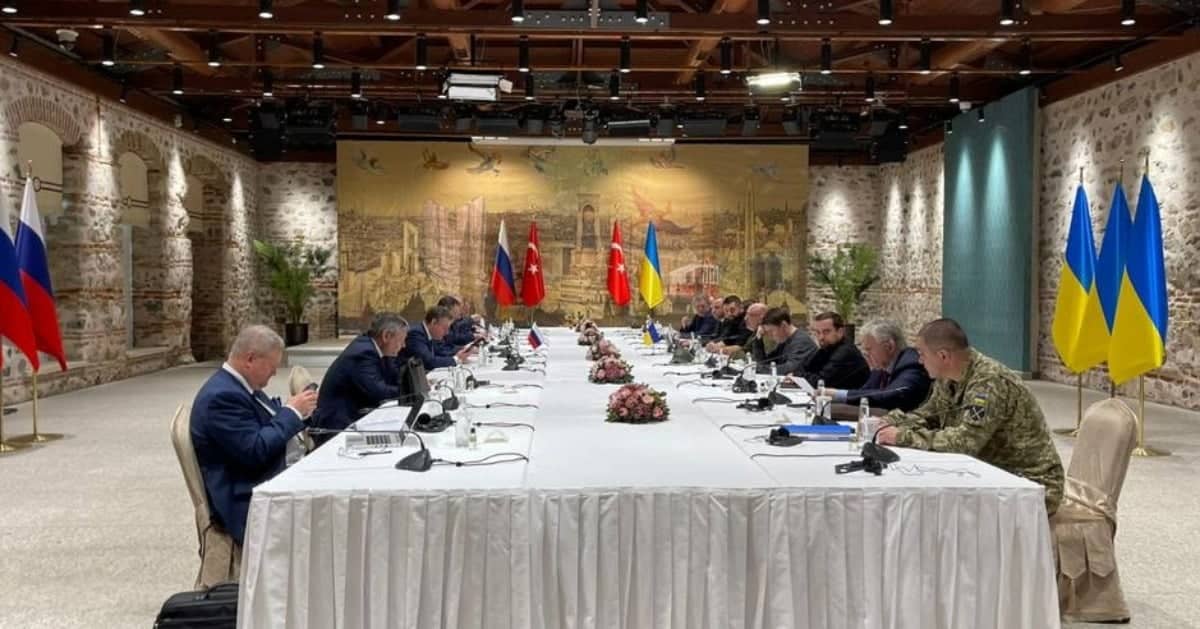
Russian and Ukrainian diplomats hold peace talks in Istanbul, Turkey, back in 2022. Photo: Turkish Presidential Press Service
Key facts
- Announcement: Putin agrees “in principle” to resume trilateral talks after Nov. 10 (Kremlin account)
- Possible venue: Abu Dhabi
- Format/Composition: Technical-level teams, per a U.S. official
- Agenda per Moscow: Post-war security system for Russia and Ukraine
- Diesel deal: Announced Oct. 10; first shipment dispatched Oct. 21 per Russian media
- Intelligence and satellites: Warnings restored after Zelenskyy’s call with Rubio; Starshield access still “limited”
- Prisoner release: U.S. citizen Stephen Hubbard freed
A Cohesive Proposal on Talks.
Putin told Witkoff he was ready “in principle” to resume the talks after Nov. 10. Kremlin adviser Yuri Ushakov said that Abu Dhabi could host them. A U.S. official said the talks would be at the technical level and that both Ukraine and Russia had accepted the proposal.
Before the three-hour meeting, Witkoff said there was “some degree of momentum.” Moscow’s reaction was mixed. Ushakov said the Oslo proposals, which he attributed to Ukraine and the European Union, held little of use. Kremlin spokesman Dmitry Peskov said Russia would study them but that the process would take a long time.
Earlier three-way rounds in Abu Dhabi and Geneva produced little beyond prisoner exchanges. Zelenskyy says a freeze along current lines is the minimum needed to end the fighting. He rejects any deal made without Kyiv: “Don’t talk about us without us,” he told Fox News.
Economic and security levers have complicated efforts at diplomacy. Witkoff thanked Putin for lifting Russia’s ban on diesel exports, saying it would ease prices for American farmers and truckers. Trump announced a deal Oct. 10 for Russia to release millions of tons of diesel over several months, which Zelenskyy called a sign of weakness. Russian state media said the first shipment left for the U.S. on Wednesday. Putin also freed U.S. citizen Stephen Hubbard, 74, and Witkoff called him “a humanitarian,” a remark Republican Sens. John Cornyn and Thom Tillis criticized.
Kyiv’s dependence on U.S. support has also been in the news. Zelenskyy said this week that Ukraine had stopped receiving advance warnings of Russian missile strikes. Warnings resumed after he spoke with Secretary of State Marco Rubio. He told Fox that access to Starshield, the military version of Starlink, remains limited, but that he expects full access to be restored.
Fighting continued. Overnight Russian attacks killed at least five people and wounded 25, Ukrainian officials said. Ukrainian drones set an oil terminal in St. Petersburg ablaze Sunday, AP reported.
Why This Matters
The agreement is procedural. Putin has committed to talk, not to concede anything, and reports indicate that talking appears to be the only concession so far. The White House hopes steps Moscow welcomed, such as the diesel deal, will make Putin more flexible. Critics, including Zelenskyy and some U.S. lawmakers, see a reward without a return.
The intelligence and satellite disputes show the pressure on Kyiv. Ukraine relies on U.S. warnings and satellite data to defend against missile and drone attacks, and Trump has said he wants Zelenskyy to make a deal. No definitive indications of a lion between the two has been credibly established. Norway’s prime minister, Jonas Gahr Støre, thinks Russia may be seeking diplomatic openings. Whether the November rounds move beyond prisoner swaps will be the real test.