
All views and opinions expressed in this article are the author’s own and are not endorsed by or reflective of Now Entertainment. As a reader-supported publication, we may receive compensation for the products and services mentioned in this story. Paid placements do not influence our independent editorial coverage. Learn more in our Advertising Policy and Editorial Policy.
When most indie genre movies focus on simplicity and tricks, Namaslay is moving in the opposite direction.
Directed by filmmaking duo Rish and Kanish, the upcoming independent feature embraces spectacle with uncommon conviction. They mix genres like horror, comedy, action, thriller, and drama into one cinematic experience inspired by Indian masala cinema. Therefore, not only does this movie seek to entertain audiences intellectually and emotionally.
Namaslay is set for an exclusive theatrical debut on August 6, 2026. The film tells the story of Gayatri, a woman who moves to Los Angeles. As she picks up Yoga again, looking to build on her grandmother’s teachings, she gets drawn into the world of an upscale yoga studio and learns something much more sinister than that of yoga.
And, while the premise leans into supernatural horror and satire, the filmmakers insist the film’s ambitions stretch beyond conventional genre boundaries.
In Indian cinema, “masala,” which means “mix,” refers to a style of film that combines several genres at once rather than limiting itself to a single tone. This process creates a new flavor distinct from its individual ingredients. That influence runs through every layer of Namaslay. Specifically, tense horror sequences coexist alongside emotional family drama, incisive comedy, kinetic thrills, and surreal supernatural imagery.
The film also carries a strong thematic focus on the commercialization of Yoga in Western culture. According to the directors, the story emerged from years of observing how spiritual traditions are often stripped of cultural context and repackaged for profit. Over time, those ideas eventually evolved into the film’s central conflict. In this way, Namaslay explores appropriation, tokenism, and identity through a cinematic lens.
“Art that has nothing to say is as worthless as food without flavor. Moviegoers today are being forced to chew and chew without a morsel of perspective ever to be served to them. We feel that, even if you disagree with what we say in Namaslay, at least we will have moved you to think—to get up from your seat and say, ‘I have an opinion on this!’ That’s what art is for.”
Rather than viewing identity as fixed, the movie looks at the ways in which race, disability, gender, culture, and class constantly intersect each other, molding not only how others view them but how they see themselves. Moreover, Gayatri is a stutterer too. While the filmmakers have brought this facet into their movie, they have done so without making her identity hinge on it.
Building an Independent Spectacle
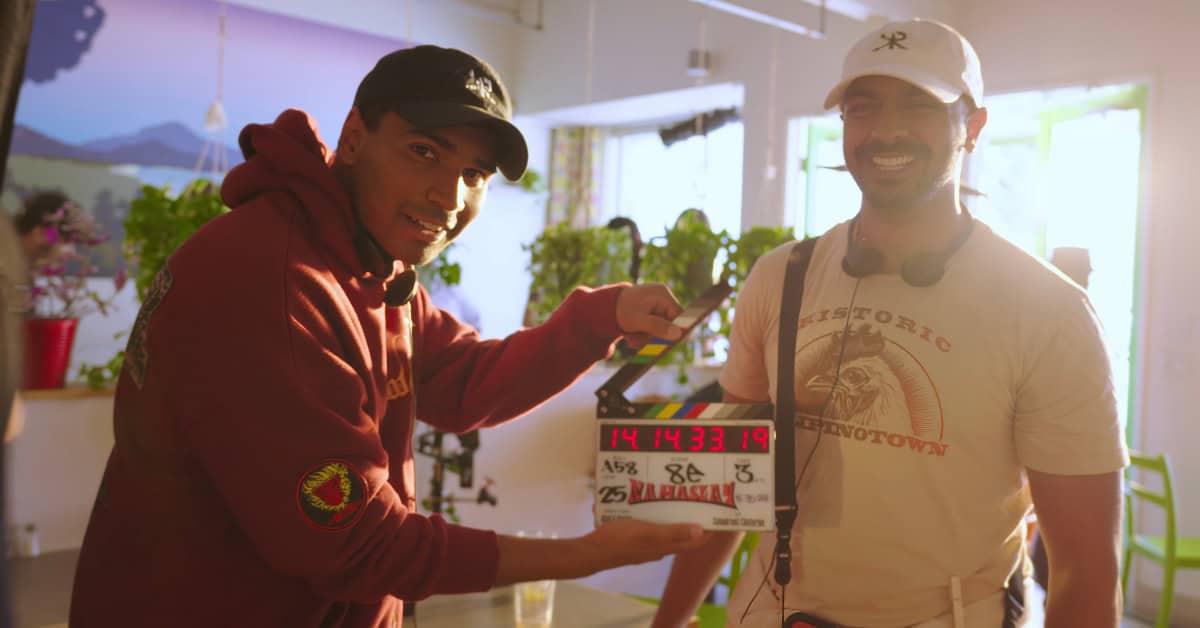
Despite operating outside the traditional studio system, Rish and Kanish approached Namaslay with strikingly ambitious visual goals. Produced independently through their company, Junghal Studios, the film incorporates elaborate visual effects, an unmistakably original score, dance choreography, vibrant cinematography, and large-scale set pieces. These qualities are more often associated with substantially larger productions.
That scale came to pose one of the main problems inherent in the entire process of production. Working with an estimated budget of $2.5 million, the filmmakers had to resort to extremely careful planning and swift adjustment. This strategy made it possible for them to accomplish some of the more complicated sequences within the project without compromising on their creativity. Among the more challenging scenes included a scene where Bharatanatyam (South Indian classical dance) sequences were used along with blue screen backgrounds that were later changed into a mythical landscape.
That independent ethos extends beyond production logistics.
Through Junghal Studios, Rish and Kanish have positioned Namaslay as part of a larger creative mission. This mission is aimed at countering what they view as an increasingly risk-averse Hollywood landscape. Rather than sanding down the film’s politics, influences, or cultural specificity in pursuit of broader commercial safety, the filmmakers leaned further into them. However, they remained dedicated to excellence in their craft.
To that end, the filmmakers state: “We’re being inundated with sequels, rehashes, remakes, and requels for a reason. Big studios believe that throwing hundreds of millions of dollars at the screen is enough to make a movie good. In doing so, they regularly demonstrate a profound lack of understanding—or even interest in—the actual craft of filmmaking. With Namaslay, we maximized the value of every last dollar by being meticulous. We worked tirelessly with our department heads and our actors. We answered every question with specificity and clarity. And we encouraged collaboration whenever possible.”
“Most importantly, we refused to change our dreams to match our reality. We changed our reality to match our dreams. That’s how all movies should be made.”
For audiences, the result of that labor will be the boldest release of 2026: a film equally invested in spectacle, emotional storytelling, and cultural commentary. It neither checks boxes nor fits inside them.
When Namaslay opens in theaters this August, Rish and Kanish assure us: “the earth will shake.”